Atmospheric scientists at Harvard’s School of Engineering and Applied Sciences (SEAS) and their colleagues expect that the frequency of wildfires will increase in many regions. The spike in the number of fires could also adversely affect air quality due to the greater presence of smoke.
Using a series of models, the scientists predict that the geographic area typically burned by wildfires in the western United States could increase by about 50% by the 2050s due mainly to rising temperatures. The greatest increases in area burned (75-175%) would occur in the forests of the Pacific Northwest and the Rocky Mountains.
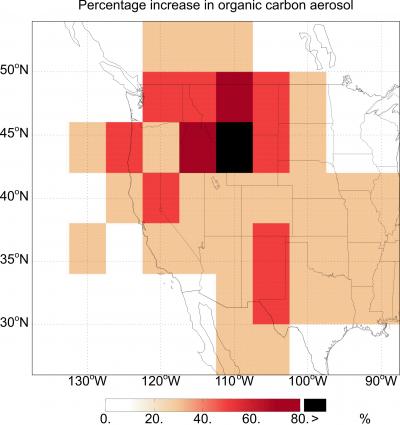
Percentage increase in organic carbon particles at the surface, from the present-day to the 2050s
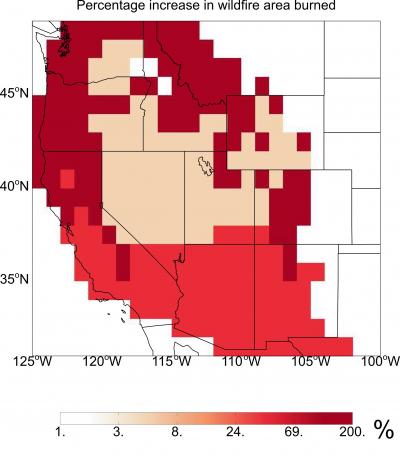
Percentage increase in area burned by wildfires, from the present-day to the 2050s
The study, led by SEAS Senior Research Fellow Jennifer Logan, was published in the June 18th issue of Journal of Geophysical Research. In their pioneering work, Logan and her collaborators investigated the consequences of climate change on future forest fires and on air quality in the western United States.
Previous studies have probed the links between climate change and fire severity in the West and elsewhere. The Harvard study represents the first attempt to quantify the impact of future wildfires on the air we breathe.
“Warmer temperatures can dry out underbrush, leading to a more serious conflagration once a fire is started by lightening or human activity,” says Logan. “Because smoke and other particles from fires adversely affect air quality, an increase in wildfires could have large impacts on human health.”
In addition, because of extra burning throughout the western U.S., one important type of smoke particle, organic carbon aerosols, would increase, on average, by about 40 percent during the roughly half-century period.
The authors expect the work will help policymakers gauge the “climate penalty” related to ongoing efforts to reduce air pollution across the United States. In addition, the study underscores the need for a vigorous fire management plan.
The team next plans to focus on future wildfires and air quality over the densely populated areas in California and in the southwest United States.
source: Eureka Alert